Friday, 24 December 2021

Last frogmouth chicks of the year 

A very large Tawny Frogmouth chick lies in its nest next to its father. The nest was set on the end of a broken branch. The chick is almost fully feathered, enough to fly, and it left the nest that evening. This was the second last chick to fledge in the Canberra study area this year, that I know of. It is the adult male who guards the chicks during the day.

The nest was set right above a popular walking and vehicle track on the edge of suburban Canberra.
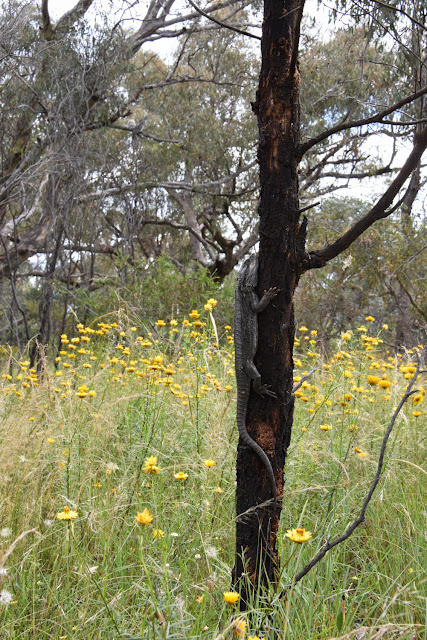
This was the last chick I know of to fledge in the area this year, last week, mid-December. This family also nested on the edge of suburbia, and frogmouths are not the only woodland wildlife to be found close to houses. This Bearded Dragon was basking on the trunk of a small tree, trying to warm up on a cloudy morning. The frogmouths are on a branch in the top left.

Their grey plumage is in the same soft tone as the grey dead branch they are perched on. Tricky to see in grey light.

One final shot of a frogmouth chick in 2021. Once they fledge they are still dependent on their parents for food as they are still only half-grown. The family will disperse through the woodland and the fledglings will leave their parents territory by the end of summer. 


Friday, 3 December 2021

Snowy Mountains - details

Lichen and bark.

Lichens growing in the socket left where a limb once grew on a Snow Gum Eucalyptus niphophila.

Longhorn tracks.

These branches of a snow Gum have been killed by borers, the larvae of a longicorn beetle Phoracantha sp. They burrow beneath the bark of the living stems, the tree dies, the bark peels away and the finger wide furrows of the larvae burrows are exposed. Meanwhile the larvae have emerged and flown off to infect another tree.

A tangle of branches.

Lichens growing on the dead branches of Snow Gums killed by the big fire of 2003.

A tangle of leaves. 

High on an alpine slope, looking through a low mat of Herbfield Celmisia Celmisia costiniana. The shine is created by the multitude of tiny hairs on the leaves, which help protect the plants from frost. 

Stars in an alpine stream. 

Alpine Marsh Marigold Caltha introloba grows in wet flushes below snow patches. It likes to have its feet wet and doesn't have much of a hold in the gravel beds.

Everlasting awakening.

A cushion of an alpine everlasting, Alpine Sunray Leucochrysum albicans. In a few weeks there will be tall stems with daisy-like heads sprouting from this tight mass of silvery woolly leaves. This is the form that the plant adopted to survive under the winter snows.

Xanthoria orange.

A tell-tale streak of Xanthoria sp. lichen growing on granite tor high on the summit ridge of the mountains. These lichens only grow where there is localised nitrogen enrichment. In this instance, there was a streak of it below a slanting crack in the rock, only a flat hand wide. The presence of the lichen hints that nitrogen was dropping out of the crack - probably very small amounts over many many years. That could have been from moth droppings, from aestivating Bogong moths Agrostis infusa.

Water lines.

Meltwater forms runnels on the surface of the old snow patches, then drips from the lip and into a stream below.

Old snow. 

Cracks opening up on a long-lying snow bed.