Saturday, 3 October 2026

 Lyrebird fledging

This bundle of sticks wedged into the base of a tree is the nest of a Superb Lyrebird Menura novaehollandiae. It measures about half a metre wide and tall. The adult female builds the nest, incubates the single egg and raises the chick on her own. The males only display, sing and mate with the females at their display mounds - see post of 10 August 2023 below. Sandra Lauer and I found this nest in August this year, when it was still winter in the forested hills near Canberra, Australia. The nest at the time contained an egg. The egg is incubated for about fifty days and the chick spends another five to six weeks in the nest. It snowed a number of days during the incubation and chick periods, but the nest is thickly lined with soft downy feathers plucked from the adult female's breat and belly.

I found a nest in 2023 that had been raided by a predator, probably a feral cat, but it was inconclusive - see post of 27 August 2023. So this time, I set up a camera trap to watch for any potential predator. Although the camera didn't detect a predator, and I couldn't determine what animal it might have been, the chick did fledge, which is good news. 

Below are a few clips of the birds' behaviour.

This is a photograph of the chick when it was about five weeks old. It is about the size of a bantam chicken, it has lost most of its first black chick down, but it is not yet fully feathered. The rufous throat feathers are showing well though. There is no room for both the chick and the adult in the nest.


In this clip, the adult female is feeding the chick in the nest, then she jumps down. There is clearly still food in her throat pouch, so she gives the chick another feed. After that, she takes a faecal sac from the chick, runs into the forest with it and either buries it or eats it as the camera stopped recording.


Here a Grey Fantail Rhipidura albiscapa comes in close to the nest as the female feeds the chick. The contact calls between the adult and chick can be clearly heard. The adult prods the chick's rear to induce it to release a faecal sac, then she quickly swallows the whole sac before jumping don from the nest.


The chick is fed once again, but it is nearing time for it to fledge from the nest and it watches its mother as she walks off through the forest, scratching in the litter for invertebrates to eat and give to the chick. The area around the nest, for about thirty metres, was well turned over by the female from her previous weeks of foraging.


The final feed at the nest. The female begins to walk away, watched by the chick. Then, with a little hesitancy, it jumps to land right next to its mother and the two birds walk of into the forest, calling to keep in contact all the way.

Thursday, 16 October 2025

Bird of the year - Tawny Frogmouth

The Tawny Frogmouth Podargus strigoides has today been voted as the bird of the year in an open poll ran by the Guardian/BirdLife Australia. This is the first year it has won the contest, although it has been runner up three times, in 2019, 2021 and 2023.This follows on from the bird being declared as the most Instagrammable bird in 2021 by a German study that found the bird had a high number of likes although it featured in a low number of posted photographs. The two chicks shown year are birds of the year. They were photographed yesterday with their dad in an old White-winged Chough nest that the parents chose for their nest site this year, rather than the usual fork in a horizontal branch. The chicks are about three weeks old and very inquisitive. They goggle at humans as they pass by below, oblivious of their presence as the birds keep still and rely on their cryptic camouflage for protection from predators. 


The chicks' front-facing eyes, bright yellow, wide, and ever-watching, are especially appealing to human emotions, but to a predator, they are a giveaway to their location. A few weeks after they fledge, they stare less and adopt the typical cryptic pose illustrated in other Tawny Frogmouth pages in this blog.


I have studied these birds for over twenty years and never tire of finding them, watching them, and following their breeding success in hot, dry, wet and windy years. Every frogmouth day is a happy day.


Saturday, 21 June 2025

 Pick of Iceland 

Kirkjufell

Fjaorargljufur

Gullfoss

Svartifoss

Svartifoss

Geyser

Ice diamond

Seal on ice

Reynisfjara Beach, stacks

Reynisfjara Beach, waves

Common Eiders Somateria mollissima nesting on Reynisfjara beach

King Eider Somateria spectabilis with Common Eiders

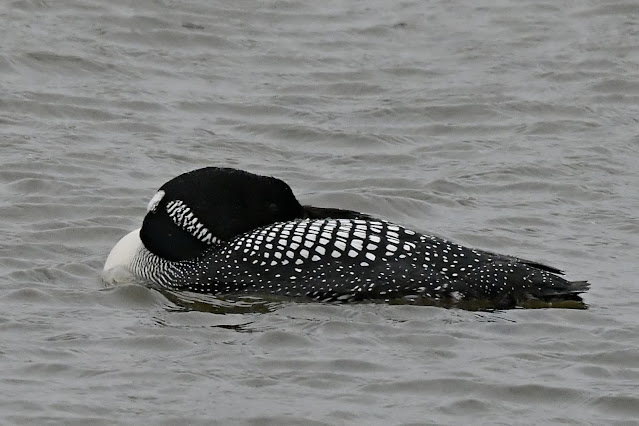
Great Northern Diver Gavia immer

Golden Plover Pluvialis apricaria

Whimbrel Numenius phaeopus

Harlequin Duck Histrionicus histrionicus

Heathland flora

Fulmars Fulmarus glacialis

Crack in basalt cliff

Grafarkirkaja Turf Church

Tuesday, 31 December 2024

Evidence of polygamy in the Tawny Frogmouth

An adult male Tawny Frogmouth sits second from the right between five fledglings. 

I recently found a brood of five fledgling Tawny Frogmouths Podargus strigoides that were being attended by one adult male and two adult females. The birds were first observed at the nest on 14 November 2024 and the birds were seen on several subsequent visits to the nest area (up to 29 Dec 2024). The nesting area was in dry sclerophyll forest on Black Mountain in the Australian Capital Territory (ACT). As far as I can determine, this is the first record of a brood of five Tawny Frogmouths.

The two adult female Tawny Frogmouths, perched on the same branch on 29 November. Female A is at the top of the branch, female B lower down on the same branch.

The observations were made while monitoring nests and broods as part of a long term study of Tawny Frogmouth breeding ecology (18 years). Six trios of breeding Tawny Frogmouths have been recorded previously in the study, although none with more than three fledglings (1x1, 2x2, 2x3, 1x failed). These records have not been published, I had planned to publish them in more context when all the data are collected. However, due to the interest in this new record, I decided to write a brief report that was published in the local bird club journal, Canberra Bird Notes 49(2) see here.  It is not known if one or both females laid the eggs in the nest in this instance. Given that frogmouths usually lay 1-3 eggs it appears that both females in this instance laid eggs and this was a polygamous relationship consisting of a breeding trio. In the article, I pondered whether this was the first record of a brood of five or of polygyny in any frogmouth species, or polygyny in any of the Caprimulgiformes. The records for the frogmouths seem to be the first of their kind, although there have been previous records of polygyny in nightjar species. 


Above left: Female A. She is overall more grey than female B. There is less rufous colouring around the face and less prominent streaks on the breast. 

Above right: Female B. She is overall more rufous, especially on the wing coverts and around the face. Her breast is more obviously streaked.

The breeding biology of the Caprimulgiformes is poorly known and they are generally thought to be monogamous (Cleere 2010). Polygyny has seemingly only been documented in four species, the Standard-winged Nightjar Macrodipteryx longipennis (Holyoak 2001), the Pennant-winged Nightjar M. vexillarius (Jackson 2004), the White-winged Nightjar Caprimulgus candicans (Pople 2003), and European Nightjar Caprimulgus europaeus (Odder Jensen 2013, Evens et al, 2024). The males of the first two species have exaggerated plumage differences from the females, such as elongated feathers, which they use for display in leks and so are considered to be polygynous. Male White-winged Nightjar also display in dispersed (exploded) leks (Frith 2024) and have been proved to mate with more than one female in a study using VHF radio tracking. The European Nightjar has only recently been proved to be polygynous in studies using GPS-telemetry.

A full report will be published on the breeding ecology of Tawny Frogmouths in the ACT when the study is completed and a separate publication will discuss polygyny in the species and other Caprimulgiformes.


The adult male frogmouth sits with four of the fledglings behind him, on 29 December. The other fledgling was with female A and female B was on a branch above them.

Cleere, N. & Nurney, D. (1998). Nightjars. – Pica Press, Sussex

Evens, R., Lathouwers, M., Creemers, J., Ulenaers, E., Eens, M., & Kempenaers, B. (2024). A Case of Facultative Polygyny in an Enigmatic Monogamous Species, the European Nightjar (Caprimulgus europaeus). Ecology and Evolution, 14(10): e70366.

Frith, C. B. (2024). Use and definitions of the terms arena, lek and court in describing avian courtship sites. Ibis.

Holyoak, D.T. (2001): Nightjars and their allies: The Caprimulgiformes. – Oxford University Press

Odder Jensen, N. (2013). A Case of Polyterritorial Polygyny in European Nightjar Caprimulgus europaeus. Dansk Ornitologisk Forenings Tidsskrift 107: 239–244.

Jackson, H. D. (2004). Courtship displays of the Pennant-winged Nightjar, Semeiophorus vexillarius. Ostrich 75: 1-4.

Pople, R. G. (2003). The ecology and conservation of the white-winged nightjar Caprimulgus candicans [Apollo - University of Cambridge Repository]. https://doi.org/10.17863/CAM.16393


 A Helping Hand

I met two Shingleback lizards Trachydosaurus rugosus yesterday while out in the bush. They were eating the flowers of conola plants, but they could only reach the lowest flowers. So, I picked some of the tallest flowers and gave them to the Shinglebacks. They were very grateful and ate them up quickly. They are mostly vegetarian, well, they are very slow moving animals.

Its nice to give a helping hand when I can.